
What Is Superwash Wool? And Why We Choose Not to Use It
Most of us already know that wool requires a little extra care. Wash it cool, handle it gently, and whatever you do, think twice before putting it in the dryer.
And yet, walk into almost any outdoor store today and you’ll find merino base layers, sweaters and other wool garments labeled “machine washable.” It’s become so common that we rarely stop to wonder: what makes wool machine washable in the first place?
The answer is often a process known as Superwash.
Wool, in its natural state, has a microscopic structure that can cause the fibers to felt and shrink when exposed to moisture, heat and agitation. Superwash treatments were developed to change that behavior, making wool easier to launder and, ultimately, easier to sell.
The convenience is obvious. But once you understand just how sophisticated the natural structure of a wool fiber is, another question emerges: What are we changing in exchange for that convenience?
First, it helps to understand why wool felts
Look at a wool fiber under a microscope and it looks nothing like the smooth strand we imagine when holding a ball of yarn. Its exterior is covered in overlapping microscopic cuticle scales, arranged somewhat like shingles on a roof. Those scales aren't an accidental imperfection; they're part of an extraordinarily complex biological structure.
The outer cuticle protects the interior of the fiber and contains an ultrathin lipid layer rich in 18-methyleicosanoic acid, or 18-MEA, which contributes to wool's natural resistance to water and dirt. At the same time, the internal structure of wool allows water molecules to move into and out of the fiber. Wool can absorb and release a remarkable amount of moisture without necessarily feeling wet, one of the reasons it performs so beautifully across changing temperatures and conditions.
That same sophisticated structure also helps explain wool's tendency to felt. The overlapping scales create directional friction between fibers; when moisture and mechanical agitation are introduced, the fibers can migrate and progressively interlock, making the fabric denser and smaller. What we experience as an inconvenient tendency to shrink is therefore connected to the natural architecture of the fiber itself.
So what does “superwash” actually mean?
Superwash isn't one single chemical or process, but rather a category of shrink-resistant treatments designed to make wool machine washable. Different technologies accomplish this in different ways, and newer chlorine-free processes exist, but one of the most established methods is the chlorine-Hercosett process.
With conventional chlorine-Hercosett treatment, a chlorine-based step modifies the scale structure at the surface of the wool, followed by the application of a polyamide-epichlorohydrin resin that helps prevent neighboring fibers from catching on one another during washing. The result is wool that is significantly more resistant to the felting and shrinkage that would ordinarily occur in a washing machine.

There is quite a bit of black-and-white language about this online. Superwash wool is sometimes characterized simply as “plastic-coated wool,” which is an oversimplification; machine-washable wool remains fundamentally wool and can retain many of the performance characteristics associated with the fiber. But it would be equally misleading to suggest that nothing meaningful happens during conventional superwash processing. The surface of the wool has been deliberately modified to change the way the fiber behaves. That is, after all, the point of the treatment.
What does the research say?
A 2019 review published in the Journal of Advanced Research examined both conventional and emerging methods of imparting shrink resistance to wool. The researchers identified several tradeoffs associated with conventional chlorine-based treatments, noting that removing or etching the scales can decrease fiber strength and contribute to yellowing. The review also discusses changes to wool's inherent stain resistance and natural feel when synthetic resin is applied, as well as environmental concerns associated with chlorine-based processing and its effluent.

Nor does the research support the idea that superwash treatment somehow erases everything that makes wool beneficial. Machine-washable wool can retain important characteristics including breathability, thermoregulation and moisture management. For us, that makes the question much more interesting than whether superwash wool is simply “good” or “bad.” We are more interested in asking how much processing we want a remarkable natural fiber to undergo when we have the choice.
Why AU Baby chooses non-superwash merino
When we began making blankets, machine washability would have been the easier commercial decision. We heard it from retailers repeatedly: customers were accustomed to easy-care textiles, and machine washability was considered an important selling point. Choosing non-superwash wool made our blankets more difficult to place with larger retailers, and for years it was a very real business liability.
We chose it anyway. Our Heirloom Merino blankets are made from NATIVA™ certified regenerative merino wool that has not undergone a superwash treatment. Rather than altering the fiber to accommodate conventional laundering, we ask people to care for the finished blanket in a way that accommodates the fiber. It requires a little more care, but the more we've learned about wool over the years, the more worthwhile that tradeoff has felt.
A wool fiber isn't simply a strand of “natural material.” It is an intricate protein structure with a protective cuticle, microscopic scales, lipids, keratin and an internal architecture capable of interacting dynamically with moisture and temperature. Even after years of working with merino, we continue to discover things about its natural structure that surprise us. The more we learn, the less interested we become in trying to improve upon what nature already designed so beautifully.

Minimally processed doesn't mean never processed
It's worth making an important distinction here: non-superwash does not mean that wool never encounters water or undergoes finishing. After knitting, our blankets go through a carefully controlled finishing process at the mill. Washing and finishing a knitted textile under professional conditions is different from treating the wool fiber specifically so that the finished product can withstand repeated domestic machine washing.
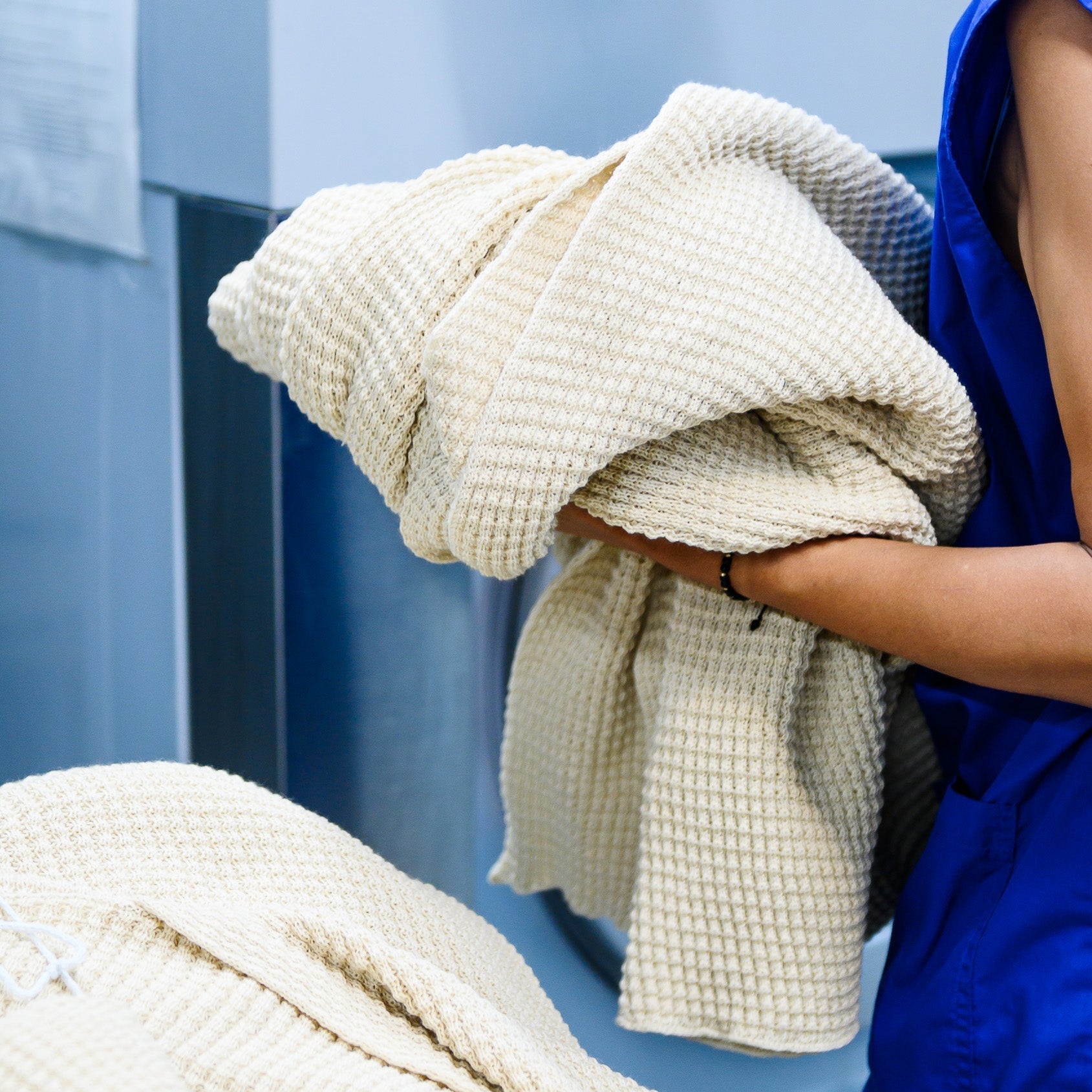
This is why you may see footage from our mill of AU Baby blankets being washed and dried during production even though we recommend more careful laundering at home. The mill controls the conditions as part of creating the finished textile; our care instructions are designed to preserve that finished blanket over years of use.
A fiber-content label only tells you the beginning of the story
This is where the conversation becomes much bigger than superwash wool. We've been taught to read fiber labels as though composition tells us everything we need to know: 100% wool, 100% cotton, 100% linen. Fiber content matters enormously, but two textiles bearing exactly the same fiber name can have remarkably different journeys before they reach your home.
Where did the fiber come from? How were the animals raised or the plants grown? How was the raw material cleaned and processed? Was it treated for shrink resistance, stain resistance or another performance characteristic? How was it dyed, and what happened during finishing? These questions reveal an entire material story that a fiber-content label alone can't tell.
This is fundamental to what we mean by Textile Wellness. We believe material literacy should extend beyond simply choosing a natural fiber and into understanding what happened to that fiber along the way. What ultimately touches our skin and enters our homes is not just “wool” or “cotton,” but the result of an entire system of agriculture, processing, chemistry and craftsmanship.
Sometimes the less convenient choice is worth making
For years, our decision to use non-superwash merino made our blankets harder to sell. What's remarkable is that we're now watching the conversation change. More people are asking not only what their textiles are made from, but where those materials came from, how they were processed and what treatments were used along the way. We're hearing from customers who actively seek out non-superwash wool—something that once felt like a commercial disadvantage.
That shift is meaningful to us because we don't believe everyone needs to arrive at exactly the same conclusion. What matters is having enough information to make the choice in the first place. People want to know so they can do better according to their own priorities, and a more informed customer ultimately asks more of the entire textile industry.
Sometimes doing what you believe is right isn't the popular choice at first. Sometimes the market catches up. We're very glad to see this one changing.
Comments