Why We Choose NATIVA™ Regenerative Merino Wool
As consumers become more familiar with certifications like GOTS, we're often asked a thoughtful question: Why isn't your Heirloom Merino collection GOTS certified like your Cashmere Cloud collection?
It's a great question. The answer starts with understanding that wool (animal-based) and cotton (plant-based) fibers have very different journeys before they become textiles. Different fibers require different standards.
When evaluating cotton, organic certification can tell us a great deal about how the crop was grown and what chemicals it may be treated with. But wool begins with a living animal and the land that supports it. For us, that means asking a different set of questions. How are the sheep treated? How is the land managed? Can we trace the fiber back to its source? What happens to the wool after it's shorn?
Those questions ultimately led us to NATIVA™ regenerative merino wool.
MEET NATIVA™
Most wool is sold as a commodity. Once a fleece leaves the farm, it often becomes nearly impossible to know exactly where it came from, how the sheep were raised, or who handled it along the way.

NATIVA™ WAS CREATED TO CHANGE THAT
As the world's first global wool brand to provide blockchain traceability from farm to consumer, NATIVA allows brands and consumers to follow the complete journey of a wool product through every stage of production. Every participant in the supply chain—from farm to finished product—is certified against NATIVA standards and documented along the way.
For us, that level of transparency matters. When a supply chain can be traced from farm to finished blanket, accountability follows naturally.
FOLLOWING THE JOURNEY OF EVERY BLANKET
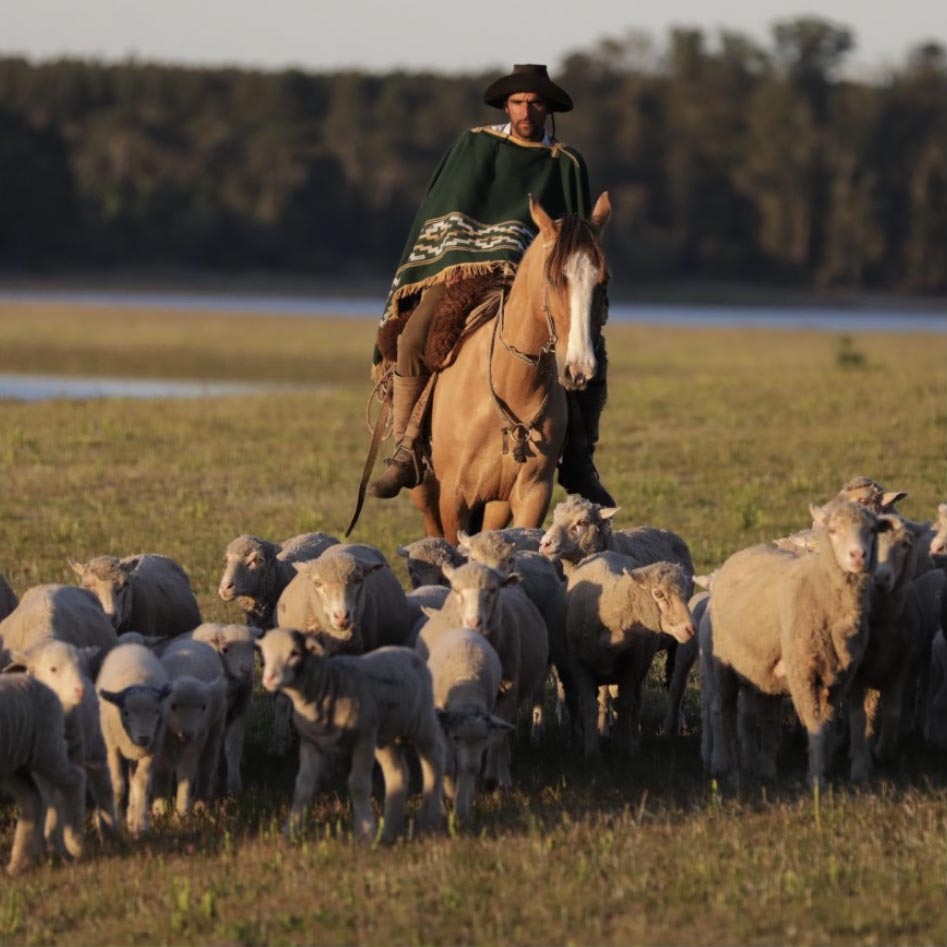
Every AU Baby Heirloom Merino blanket begins on a NATIVA-certified regenerative family farm in Patagonia.
From there, the wool travels through a fully certified supply chain:
• Certified regenerative farms
• Wool sourcing and combing
• Wool spinning
• Knitting and hand finishing
At every stage, participants are certified to NATIVA protocol standards, creating an unusually transparent supply chain from sheep to blanket.
REGENERATIVE AGRICULTURE STARTS WITH THE LAND
One of the many reasons we chose NATIVA is that the program evaluates far more than the wool itself. Certified farms are assessed against standards that include animal welfare, land management, biodiversity, ethical labor practices, social responsibility and environmental stewardship. The goal isn't simply to sustain the land, but to actively improve it for future generations.
Rather than viewing sheep and land as separate systems, regenerative agriculture recognizes that healthy animals and healthy ecosystems depend on one another. That philosophy closely mirrors our own approach to textile wellness: caring for the entire system, not just the finished product.

WHY WOOL IS DIFFERENT
When consumers think about organic certifications, they're often thinking about cotton, where pesticide, herbicide, and fungicide use can play a significant role in cultivation. In fact, it's estimated that conventional cotton accounts for roughly 10-16% of global insecticide use and around 4-7% of total pesticide use worldwide, despite using only a small percentage of global farmland.
Wool presents a different set of questions. For us, the most important considerations are how the sheep are treated, how the land is managed, whether the fiber can be traced, and how it is processed after shearing.
That's why we chose to prioritize NATIVA™ regenerative wool, which is double certified through both the Responsible Wool Standard (RWS) and NATIVA™ protocols. The RWS protocol is the wool industry's highest voluntary standard for animal welfare and deserves it's own article. However, we'll suffice to say that under RWS, sheep enjoy protection of their 5 Basic Freedoms. The most important that they are free to be sheep, not just vessels for their fleece. Their happiness and dignity come first!
A NATURALLY HIGH PERFORMING FIBER
Long before sustainability became a marketing term, wool evolved to perform remarkably well on its own. Merino wool is renewable, with sheep producing a new fleece every year. It is biodegradable, naturally breathable, temperature regulating, moisture managing, odor resistant, and naturally protective against UV exposure.
Unlike synthetic fibers, wool does not shed persistent microplastics into waterways when washed. It also requires less frequent washing than many other fibers thanks to its natural odor resistance and performance properties.
Because wool is both durable and recyclable, its environmental story continues long after it leaves the farm. For us, that's one of the most compelling aspects of the fiber itself: Mother Nature already engineered many of the qualities modern performance textiles are trying to replicate.
BEYOND SYNTHETIC DYES
The wool itself is only part of the story. After sourcing our fiber, we partner with a family-owned mill in Northern Italy that has spent decades refining a rare approach to natural coloration. Our shades are created using sustainably sourced botanicals such as indigo, henna, weld, juniper, Indian bark, and cochineal.
What makes this process especially unusual is what isn't used. Our mill avoids synthetic dyes, mordants, fixatives, and many of the auxiliary chemicals commonly found in textile dyeing. The process is certified through Woolmark's Natural Coloration program.
For us, this matters for several reasons. It reduces the chemical burden on wastewater, creates a healthier working environment for the people handling the materials every day, and aligns with our belief that textiles should be as thoughtful as the families who use them.
The wool itself remains completely untreated, which is why we recommend gentle hand washing. We intentionally chose to leave the fiber as close as possible to its natural state.

WHY WE CHOSE THIS PATH
Long before I became a mother, I set out to create the kind of blanket I couldn't find anywhere else. As a material innovator, I knew that every textile is ultimately a collection of choices: where the fiber comes from, how it's grown, how it's processed, how it's dyed, and what ends up touching our skin every day.
I wanted to create a blanket that was soft enough for a newborn, gentle enough for sensitive skin, and thoughtful enough to feel good about every step of its journey.
That meant choosing regenerative merino wool raised to the highest standards of animal welfare. It meant insisting on full traceability from farm to finished blanket. It meant working with a mill willing to color wool with botanicals instead of synthetic dyes and avoiding the chemical treatments commonly used throughout the industry.
In other words, I wanted to create the safest, softest, most sustainable baby blanket I knew how to make—with ingredients you can actually pronounce.
When I later met with the Woolmark team in Sydney, they remarked that they were unaware of another commercially available blanket combining regenerative merino wool, Responsible Wool Standard certification, untreated fiber, and Woolmark-certified botanical dyeing.
For me, that wasn't validation that we had chosen an unusual path. It was confirmation that the details matter. Because a truly thoughtful textile isn't defined by a single certification or claim. It's the result of thousands of decisions made throughout the entire supply chain.
And those decisions are exactly what inspired AU Baby from the beginning.
OUR APPROACH TO TEXTILE WELLNESS
At AU Baby, we often talk about textile wellness: the idea that what touches our skin all day and all night matters.
For us, that philosophy extends far beyond softness. It includes where fibers come from, how they're raised, how they're dyed, how they're processed, and the impact they have on the people and environments behind them.
The Heirloom Merino collection was built around that belief from the very beginning. And we're incredibly proud to share that story with you.
Comments